
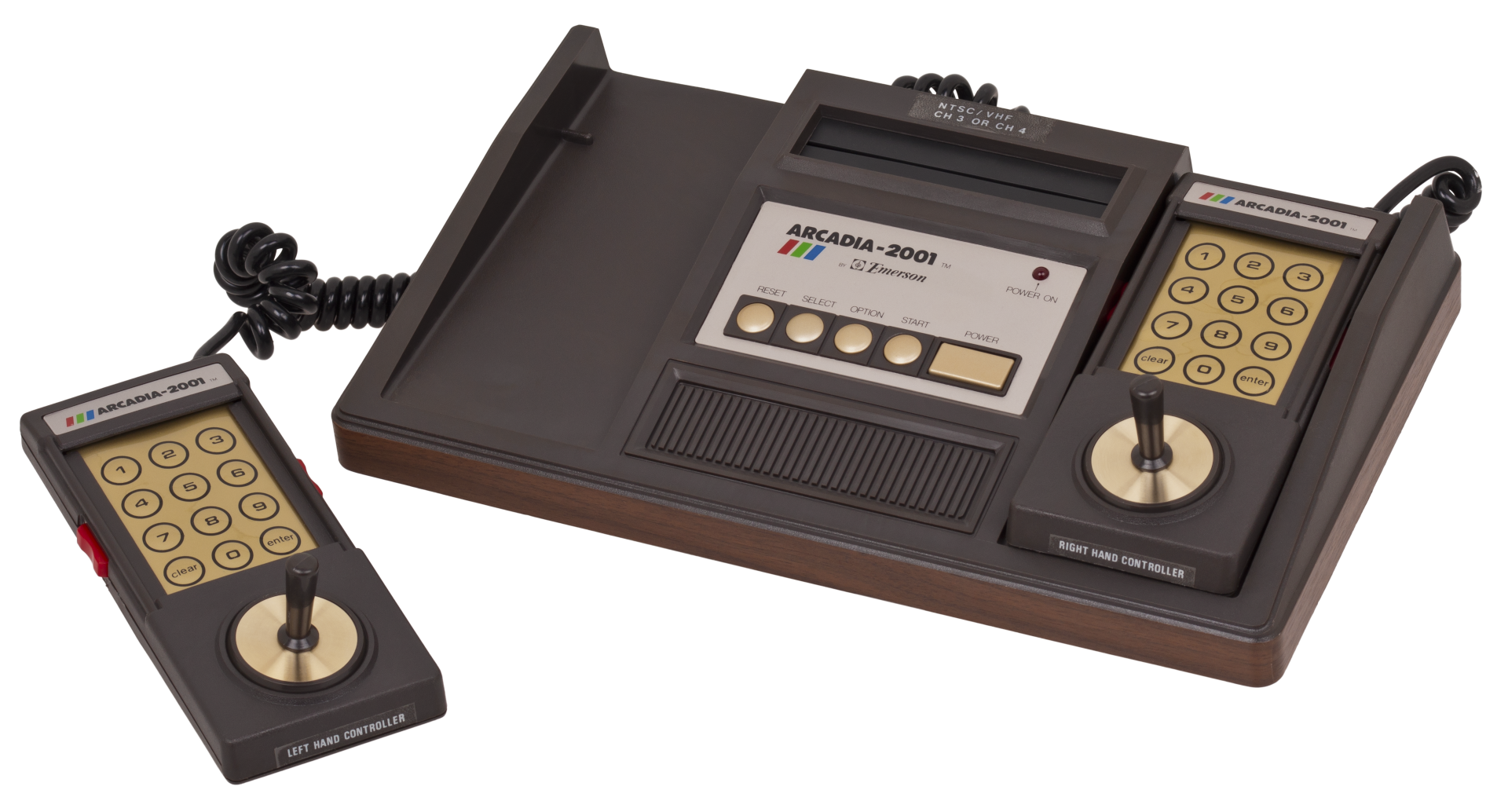
Disclaimer: The Emerson Arcadia 2001 bring-up has been done in emulation only. The firmware and software run in a patched MAME, but there is no cartridge PCB design yet and nothing has run on a real Arcadia. We could use some help: designing a level-shifted cartridge PCB, building a breadboard prototype, and trying the firmware and software on real consoles. If you can help, please get in touch on the FujiNet Discord.
Status
The firmware and software for the Emerson Arcadia 2001 bring-up are now working in emulation (a patched MAME, against FujiNet-PC). A browse-and-boot CONFIG is built into the cartridge and comes up at power-on; it browses host slots and directories, and cartridge images load over the network. All 48 commercial game images stream through the cartridge byte for byte and boot. A console reset re-runs the client with a fresh sequence number, so it never sees an old reply. The full CONFIG is written but is not yet built into the cartridge firmware. There is no cartridge PCB yet, so nothing has run on a real console.
Firmware
Current firmware can be pulled from https://github.com/FujiNetWIFI/fujinet-firmware
The cartridge is a new design: an RP2040 that serves the Signetics 2650 bus in software. The cartridge edge carries only A0-A13, D0-D7, +5 V and ground: no write strobe, no clock and no reset. So, as on the Astrocade, both directions ride on reads: the console talks to the cartridge through the address of each read in a hotspot window, and the cartridge answers with bytes it puts in the window it serves. A12 is the chip select and A13 picks the 4K block, so the console sees the cartridge as two 4K blocks at $0000 and $2000, with the mailbox at the top of the second. It takes 8K .bin images; there is no bank switching.
The RP2040 section of the firmware is in pico/arcadia/firmware. Build instructions in pico/arcadia/README.md
The ESP32S3 version of the firmware can be built with:
./build.sh -s fujiversal-arcadia
./build.sh -cbufm
The cartridge is a separate RP2040 joined to the ESP32S3 only by USB, so the ESP32S3 build does not carry the cartridge firmware; build it in pico/arcadia with ./build-cart.sh. On master the cartridge firmware carries a stand-in browse-and-boot CONFIG; to build in the full CONFIG, copy build/config.bin from fujinet-config’s arcadia/ to pico/arcadia/build/ first. The ESP32S3 pin map is provisional (the Freenove ESP32-S3 CAM pins, carried over from the Astrocade). The first things to check with a scope on real hardware are the address settle time against the firmware’s two samples 100 ns apart, and the data-out timing against the bus cycle (about 3.35 µs).
Hardware
There is no cartridge PCB yet. The firmware’s first cut is a plain Raspberry Pi Pico (RP2040) on a breadboard or adapter, joined by USB to an ESP32-S3. The Arcadia bus is 5 V TTL and the RP2040 is not 5 V tolerant, so a real cartridge needs level shifters on the 14 address inputs and the 8 data outputs. The pin map is in pico/arcadia/firmware/include/arcadia_cart.h: GP0-GP13 are A0-A13 (A12 is the chip select), GP14-GP21 are D0-D7, and GP22, GP26 and GP27 are reserved for a self-test trigger, a console 5 V sense and a debug UART.
The first hardware check needs no cartridge: pico/arcadia’s fujitest.bin is a valid 8K EPROM image, and burned to an EPROM it should show NO FUJINET CART on a real console.
There is no DIY option yet; until a board exists, the Arcadia side can be tried in emulation with a patched MAME: pico/arcadia/emu/apply.sh adds the FujiNet cartridge to a MAME source tree, and pico/arcadia/run.sh runs it against FujiNet-PC. MAME’s arcadia driver needs no BIOS ROMs.
Software
Current FujiNet Software Ported:
| Program | GitHub |
|---|---|
| Config | https://github.com/FujiNetWIFI/fujinet-config in arcadia/ |
| 5 Card Stud Poker | https://github.com/FujiNetWIFI/fujinet-5cardstud in arcadia/ |
| Battleship | https://github.com/FujiNetWIFI/fujinet-battleship in arcadia/ |
| Fujitzee | https://github.com/FujiNetWIFI/fujinet-fujitzee in arcadia/ |
| Lobby | https://github.com/FujiNetWIFI/fujinet-lobby/tree/arcadia in arcadia/ |
The Arcadia programs are standalone Signetics 2650 assembly, built with Macroassembler AS; there is no fujinet-lib target for the Arcadia. Config and the three games have been merged; the lobby is on fujinet-lobby’s arcadia branch.
FujiNet Go
There is no FujiNet Go for the Arcadia yet; use the patched MAME described under Hardware.